What a vintage handwritten Christmas font for festive packaging actually does
A vintage handwritten Christmas font for festive packaging adds warmth and intentionality to physical holiday items think gift tags, bakery boxes, or small-batch candle labels. It signals care, not mass production. Unlike sleek sans-serifs, these fonts carry slight irregularities: uneven baselines, subtle ink bleed, or soft pencil-like edges that mimic real pen-on-paper motion.
When is this style the right choice?
Use it when your product feels handmade, nostalgic, or locally rooted. A maple syrup brand in Vermont benefits more from a rustic handwritten Christmas font for invitations than a tech startup launching limited-edition ornaments. It fits best on kraft paper, linen wraps, or cream-colored cardstock not glossy foil-stamped boxes. If your packaging already includes hand-drawn illustrations or stamped wax seals, the font reinforces that cohesive tactile language.
How to match it to your brand’s tone
Not all vintage handwriting reads the same. Tight, upright loops with fine hairlines suggest quiet elegance ideal for luxury soaps or artisanal teas. Looser, bouncy letterforms with visible pressure variation suit playful bakeries or children’s toy shops. For consistency, pair it with one supporting typeface: a simple serif like Garamond for body text, or a clean sans-serif like Lato for small print. Avoid mixing two decorative scripts they compete instead of complement.
Common technical mistakes and how to fix them
Scaling the font too large makes wobbles look uncontrolled; too small hides its charm. Stick to 14–24 pt for printed tags, 36–60 pt for front-of-box emphasis. Kerning often needs manual adjustment especially around “&”, “ff”, or “tt” since auto-spacing assumes mechanical uniformity. Also, avoid overusing swashes or alternate characters unless they appear consistently across all touchpoints. One tag with a fancy “C”, another without, breaks visual trust.
How to test it before printing
Print a full mockup on your actual substrate not just white office paper. Ink absorption changes how curves soften or lines thicken. Hold it at arm’s length: can you read “Handmade in Maine” clearly? Does “Merry Christmas” feel joyful, not cramped or fussy? Compare side-by-side with a more elegant handwritten Christmas font for branding if you’re unsure about formality level.
Your quick checklist before finalizing
- Font is licensed for commercial packaging use (not just desktop)
- Test-printed on final material, not screen-only preview
- Letter spacing adjusted manually where needed, especially around punctuation
- Used consistently across all physical elements: tags, stickers, box stamps, and ribbon labels
- Paired with only one secondary typeface no script + script combos
- Reviewed alongside a handwritten Christmas font for holiday cards to ensure tonal alignment
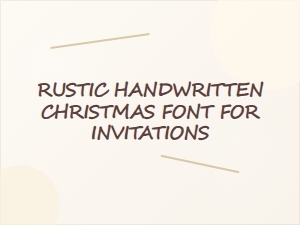 Rustic Handwritten Christmas Font for Invitations
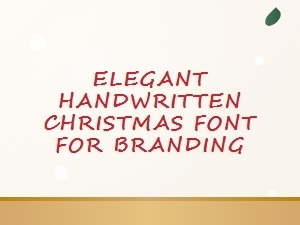 Elegant Handwritten Christmas Font for Branding
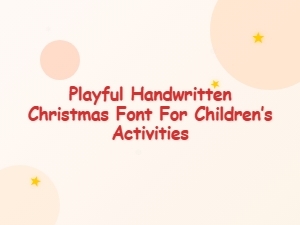 Playful Handwritten Christmas Font for Kids
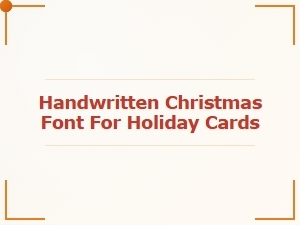 Handwritten Christmas Fonts for Holiday Cards
 Retro Holiday Typeface for Vintage Greeting Cards
 Vintage Christmas Font for Hand Lettering